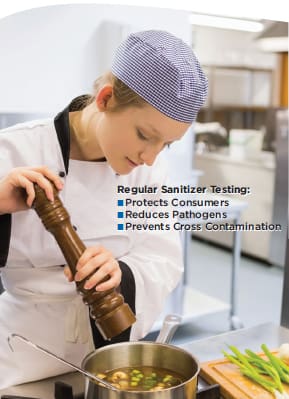
How Often Should You Test Sanitizer Solution
Ask five kitchen managers how often they test sanitizer and you'll get five different answers. Some test once a shift. Some test only when they remember. The real answer is more specific than either of those. Get it wrong and a station that passed at 8am can be running on weak sanitizer by lunch.
How Often Should Sanitizer Be Tested
Most food safety programs call for testing at the start of each shift and any time you mix a new batch. That's the baseline. But solution strength doesn't stay constant. Chlorine sanitizer breaks down through the day, especially in warm water or when food debris gets into the bucket. A concentration that tested fine at 8am can be too weak by noon.
Because of that, busy kitchens test every two to four hours during service. Not just once at the start of a shift. Busy operations like school cafeterias during lunch rush or fast casual spots during dinner rush should lean toward the two hour mark.
What Changes How Often You Should Test
A few things speed up how fast sanitizer breaks down.
- Water temperature, since hot water speeds up chlorine breakdown
- Organic material, since food scraps and grease use up sanitizing power fast
- Sunlight and heat exposure near the sanitizer station
- How often the bucket gets topped off versus fully remixed
If any of these apply in your kitchen, test more often than the baseline, not less.
Do You Need to Test Every Sink or Just One
Test every sanitizer station separately. A three compartment sink, a bar area and a prep station all need their own check, since concentration can vary by station even if everyone filled up from the same source. Wiping cloths in a bucket at a server station can dip below safe levels faster than a sink that's less frequently used.
What's the Easiest Way to Build Testing Into a Shift
The kitchens that stay consistent build testing into an existing habit, not a separate task. Pair it with something staff already do on the clock, like a temperature check or a side work list. Posting a simple log sheet near the sink helps too, since a written record shows an inspector that testing actually happens on schedule, not just when someone remembers.
A quick tip that works well in busier kitchens: keep the test strips right next to the sanitizer bucket, not in a drawer across the room. Distance is the number one reason testing gets skipped during a rush.
What Happens If You Skip a Testing Cycle
Missing one test isn't usually a big deal if the rest of your log is solid. But a pattern of gaps is exactly what inspectors look for, since it suggests sanitizer strength isn't being monitored consistently. It also means your kitchen has no way of knowing if a solution went weak somewhere in the middle of service.
Micro Essential Lab Makes Testing Fast and Simple
Our chlorine and quat sanitizer test strips are built for quick reads, so testing every two hours doesn't slow down a busy line. We've supplied restaurants, school kitchens and food processing plants with test papers since 1934, and we know testing only works if it's easy enough that staff actually do it every time.
Check out our sanitizer and disinfectant test kits to find strips built for your specific sanitizer type, or read our guide on choosing a sanitizer for your food facility if you're still deciding what to use.